


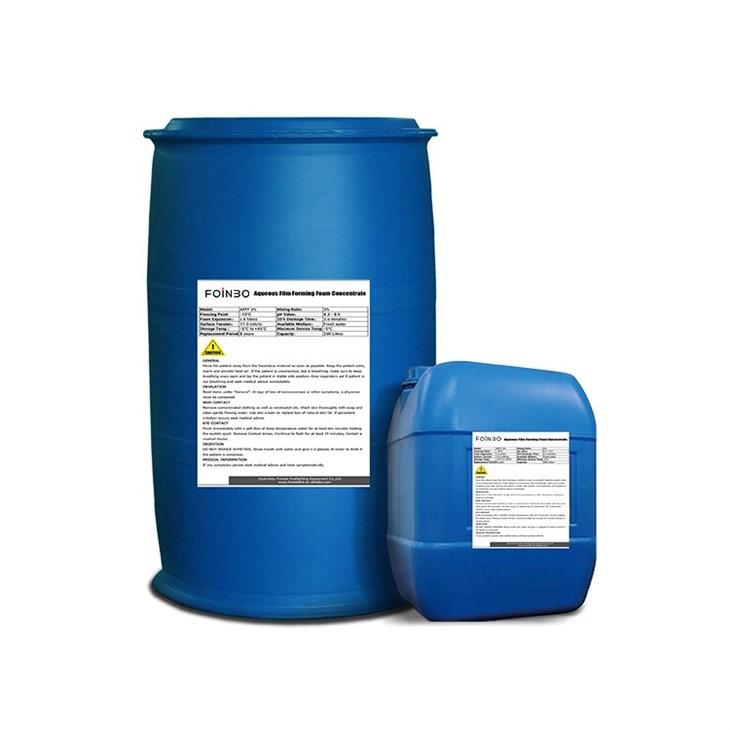
Production introduction
Available in 3% and 6% concentrate formulations, Foam Fire Afff adapts to diverse operational needs. The 3% variant is ideal for high-flow systems, while the 6% option works efficiently in low-pressure setups. Both formulations exhibit a pale amber hue and a pH range of 7.5–8.5, ensuring compatibility with most firefighting equipment and minimal corrosion risk to metal components.
Key performance metrics of Foam Fire Afff include a surface tension of 15.8–17.3 mN/m, allowing rapid spread across liquid surfaces, and an expansion ratio of 7.2±1, producing dense foam that adheres to vertical surfaces. Its 25% drainage time (3.8–4.5 minutes) exceeds industry standards, ensuring prolonged flame suppression. The foam remains stable in temperatures ranging from -10°C to 50°C, making it suitable for both cold climates and hot industrial environments.
Foam Fire Afff finds applications in refineries, chemical plants, airport hangars, and storage facilities. Its ability to extinguish fires in confined spaces, such as tanker trucks or storage tanks, adds to its versatility. When diluted with water (per 3% or 6% ratios), it generates a foam blanket that cuts off oxygen supply and cools the fuel source simultaneously.
Products Parameters
|
Model |
AFFF 6% (-1℃) |
AFFF 6% (-16℃) |
AFFF 6% (-35℃) |
|
Appearance |
Clear Pale Yellow Liquid |
||
|
PH |
8.3-8.8 |
7.4-7.7 |
8.5-8.7 |
|
Surface Tension |
16.2 mN/m |
16.2 mN/m |
18.1 mN/m |
|
Spreading Coefficient |
6.5-6.9 mN/m |
6.4-6.7mN/m |
4.7-4.9 mN/m |
|
Viscosity @ 20℃ |
≤20 MPas |
≤20 MPas |
≤20 MPas |
|
Expansion Ratio |
7.9±1 |
6.6±1 |
7.8±1 |
|
25% Drainage Time |
3.1( 1±20% ) min |
3.4( 1±20% ) min |
3.2( 1±20% ) min |
|
Freezing Point |
-1℃ |
-16℃ |
-35℃ |
Products Description


FAQ
Q: How does Foam Fire Afff compare to dry chemical extinguishers for liquid fires?
A: Foam Fire Afff is more effective for large-scale liquid fires as it creates a persistent barrier, preventing re-ignition. Dry chemicals work for small fires but may require reapplication and can damage sensitive equipment.
Q: Can Foam Fire Afff be used on polar solvents like alcohol or acetone?
A: Standard formulations are designed for hydrocarbon fuels. For polar solvents, use Foam Fire Afff variants labeled "alcohol-resistant," which contain special polymers to resist fuel breakdown.
Q: What is the impact of water hardness on Foam Fire Afff performance?
A: Hard water (high mineral content) can reduce foam expansion. Use water softeners or select Foam Fire Afff with anti-scaling additives to maintain optimal performance in hard water regions.
Q: How long does the protective foam blanket from Foam Fire Afff last after application?
A: Under calm conditions, the blanket remains effective for 20–30 minutes. Wind or agitation may reduce this time, so reapplication is recommended if the area remains at risk.
Q: Is specialized training required to handle Foam Fire Afff concentrates?
A: Yes, training ensures proper dilution ratios, equipment compatibility, and safe handling. Incorrect mixing can reduce efficacy, while skin contact with concentrated Foam Fire Afff may cause irritation without proper PPE.