


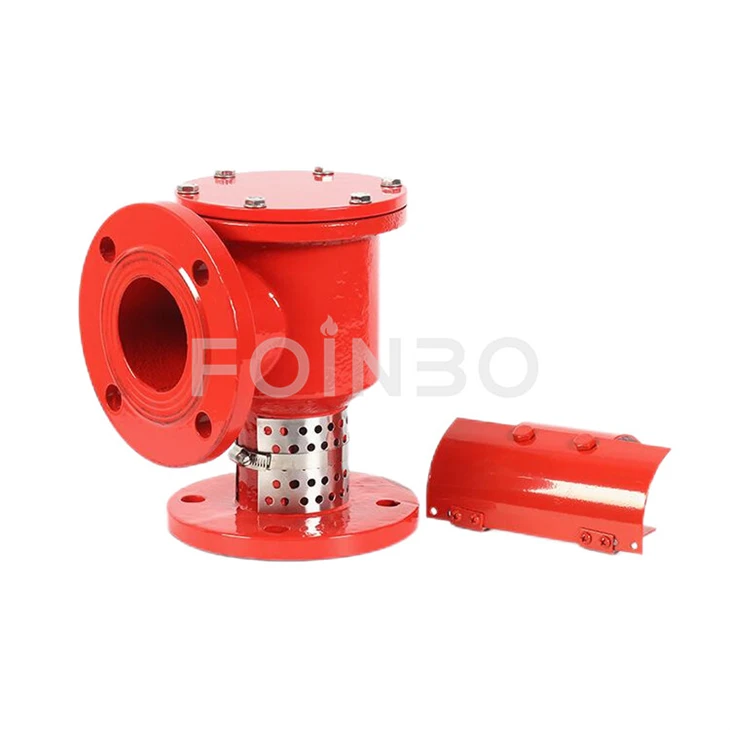


Production introduction
The foinbo® Low Expansion Foam Chambers For Firefighting are specialized fire suppression components designed to protect 中小型 (medium-to-small) industrial facilities, warehouse storage tanks, and regional fuel depots-settings where space constraints or retrofitting needs demand compact, high-efficiency solutions. Unlike large-scale fixed systems, these chambers prioritize easy integration and targeted protection: Low Expansion Foam Chambers For Firefighting generate dense, low-expansion foam (≥5 times expansion ratio) that adheres tightly to flammable liquid surfaces, smothering flames and blocking oxygen to prevent re-ignition, even in confined tank spaces.
Constructed from carbon steel with a double-layer epoxy coating (for enhanced resistance to chemical corrosion from fuels like diesel or kerosene), Low Expansion Foam Chambers For Firefighting balance durability with lightweight design-each unit weighs 12–28kg (depending on model) for straightforward ceiling or wall mounting. They operate within a working pressure range of 0.25–0.55MPa, a more flexible range than standard chambers, making them compatible with both low-pressure portable pumps and fixed firefighting pipelines. Four model variants cater to diverse flow needs:
- PCL3: 180 LPM flow, 1.5″ inlet/2″ outlet (ideal for small solvent tanks)
- PCL6: 360 LPM flow, 2″ inlet/2.5″ outlet (for medium fuel storage)
- PCL12: 720 LPM flow, 3″ inlet/4″ outlet (for large warehouse tanks)
- PCL18: 1080 LPM flow, 4″ inlet/5″ outlet (for regional fuel depots)
Products Parameters
|
Model Number |
Type |
Flow Rate |
Inlet Size |
Outlet Size |
|
PCL4 |
Low Expansion,vertical |
240LPM |
50mm(2'') |
80mm (3'') |
|
PCL8 |
Low Expansion,vertical |
480LPM |
65mm(2.5'') |
100mm(4'') |
|
PCL16 |
Low Expansion,vertical |
960LPM |
80mm (3'') |
150mm(6'') |
|
PCL24 |
Low Expansion,vertical |
1440LPM |
100mm (4'') |
200mm (8'') |
Products Features
| Body Material |
Carbon Steel; |
| Working Pressure Range |
0.3-0.6MPa; |
| Expansion | Low expansion,≥5 Times; |
| 25% Liquid Drain Time | ≥ 120 s; |
|
Flange Standard of Proportioner |
ANSI / BS4504 / GB; |
| Surface Finishing | Painting |
Products Description


Products Detailed

FAQ
Q: Can Low Expansion Foam Chambers For Firefighting be installed on inclined tank walls (e.g., 15° slope) instead of flat surfaces?
A: Yes, but use the optional angle-adaptation bracket (sold separately) to secure the chamber. The bracket adjusts to slopes up to 20° and ensures the foam outlet remains aligned with the tank's interior, preventing foam from pooling unevenly on one side.
Q: How to remove dried foam residue from the internal components of these chambers after a fire event?
A: Flush the chamber with high-pressure water (3–5 bar) through the inlet for 5 minutes to loosen residue. For stubborn deposits, use a non-abrasive nylon brush to scrub the internal walls-avoid metal tools, as they can scratch the epoxy coating and reduce corrosion resistance.
Q: Do these chambers require a separate pressure regulator when connected to high-pressure fire hoses (e.g., 1MPa)?
A: Yes, a pressure regulator (set to 0.25–0.55MPa) is mandatory. High-pressure hoses exceed the chamber's maximum working pressure, which can damage internal valves and disrupt foam expansion. Most regulators compatible with BS4504 flanges work with these chambers.
Q: When selecting a model, do I need to consider the distance between the chamber and the foam supply pump?
A: Absolutely. For pump-to-chamber distances over 50 meters, choose a model with a larger inlet size (e.g., PCL12 or PCL18) to compensate for pressure loss in long hoses. Use a pressure calculator (provided in the user manual) to match model flow rate with your site's hose length.
Q: What steps should be taken if the chamber's foam expansion ratio drops below 5 times during routine testing?
A: First, check for clogs in the foam outlet (use a soft wire to clear debris). If expansion remains low, inspect the chamber's internal diffuser-replace it if cracked or worn. If issues persist, verify the foam concentrate's dilution ratio (3% or 6%) is correct, as incorrect mixing often reduces expansion.