

What is the effect of foam nozzle orientation on foam spraying?
As a supplier of foam nozzles, I've witnessed firsthand the critical role that these components play in various applications, particularly in fire - fighting scenarios. One aspect that often goes overlooked but is of great significance is the orientation of the foam nozzle during spraying. In this blog post, we'll explore the effects of foam nozzle orientation on foam spraying and why it matters.
1. Understanding Foam Nozzles
Before delving into the impact of orientation, it's essential to have a basic understanding of foam nozzles. Foam nozzles are designed to mix water and foam concentrate to produce a stable foam that can be used to suppress fires, especially those involving flammable liquids. There are different types of foam nozzles, each with its own unique design and characteristics, such as fixed - pattern nozzles and adjustable - pattern nozzles. You can learn more about our high - quality foam nozzles on our website: Foam Nozzle Fire Fighting.
2. Impact on Foam Coverage
The orientation of the foam nozzle has a direct impact on the coverage area of the foam. When the nozzle is oriented horizontally, the foam tends to spread out over a larger area on a flat surface. This is ideal for covering large spills of flammable liquids or for protecting a wide expanse of a fire - prone area. For example, in an industrial setting where there are large storage tanks of flammable materials, a horizontally oriented nozzle can quickly cover the surface of the liquid in case of a spill, preventing ignition and suppressing any existing flames.
On the other hand, a vertically oriented nozzle can be more effective for reaching elevated areas or for directing the foam upwards. In a multi - story building fire, a vertically oriented nozzle can be used to send foam up to higher floors, helping to extinguish fires in areas that are difficult to access from the ground. Our Firefighting Foam Nozzle is designed to provide optimal performance in different orientations.
3. Foam Quality and Stability
The orientation of the nozzle also affects the quality and stability of the foam. When the nozzle is oriented at an improper angle, the mixing of water and foam concentrate may be disrupted. For instance, if the nozzle is tilted too far forward or backward, the flow of the two components may not be well - balanced, resulting in a less stable foam. A stable foam is crucial as it can adhere to surfaces better, providing longer - lasting fire suppression.
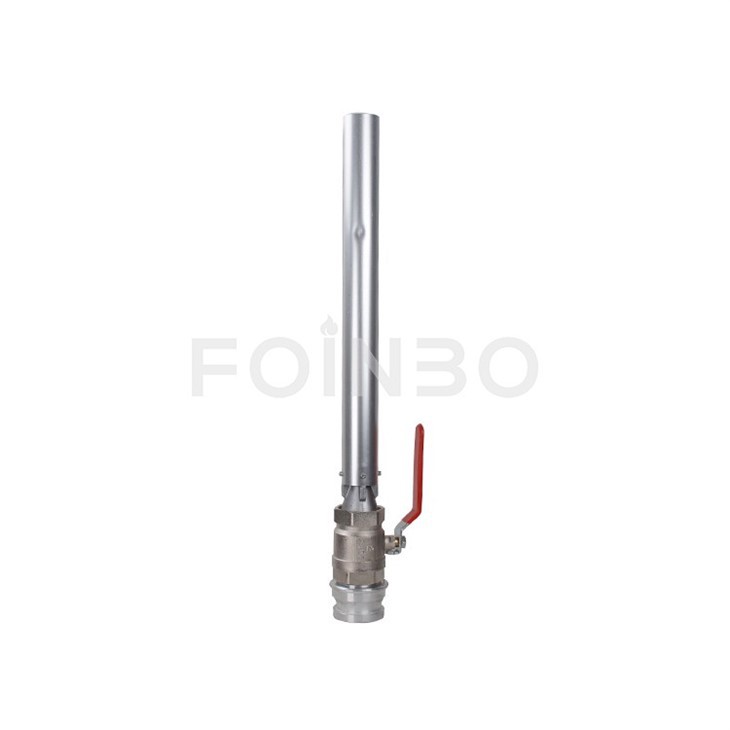
A well - oriented nozzle ensures that the foam has the right consistency and structure. A properly oriented nozzle allows for the correct amount of air to be entrained into the foam mixture, which is essential for creating a high - quality foam. Our Foam Nozzle Firefighting is engineered to maintain the proper mixing ratio regardless of the orientation, ensuring consistent foam quality.

4. Reach and Penetration
The reach of the foam spray is another factor influenced by nozzle orientation. A forward - angled nozzle can project the foam further, which is useful for reaching fires that are located at a distance. This is particularly important in large open areas such as airports or industrial yards. In contrast, a downward - angled nozzle can provide better penetration into confined spaces or through dense smoke. In a fire in a cluttered warehouse, a downward - angled nozzle can direct the foam into the gaps between stored goods, reaching hidden flames.
5. Considerations for Different Applications
- Industrial Fires: In industrial settings, where large - scale fires involving flammable liquids are a concern, the orientation of the foam nozzle needs to be carefully considered. For large storage facilities, horizontal orientation may be preferred for initial coverage, while vertical or angled orientations can be used for targeting specific areas or for reaching elevated equipment.
- Structural Fires: In building fires, the orientation will depend on the location of the fire. For fires on lower floors, horizontal or downward - angled nozzles may be used. For upper - floor fires, vertical or upward - angled nozzles are more appropriate.
- Wildland Fires: In wildland fire - fighting, the orientation can be adjusted based on the direction of the wind and the topography of the land. A nozzle can be oriented to follow the wind direction to maximize the spread of the foam over the burning area.
6. Training and Best Practices
Proper training is essential for firefighters and other users of foam nozzles to understand the importance of nozzle orientation. Operators should be trained to adjust the orientation of the nozzle based on the specific fire scenario. Regular practice sessions can help them become more proficient in using the nozzle in different orientations to achieve the best results.
Best practices also include conducting pre - fire planning to determine the optimal nozzle orientation for different areas of a facility or location. This can involve mapping out potential fire hazards and identifying the best angles for foam spraying.
7. Our Role as a Foam Nozzle Supplier
As a foam nozzle supplier, we are committed to providing high - quality products that perform well in various orientations. Our research and development team continuously works on improving the design of our nozzles to ensure that they can adapt to different fire - fighting needs. We also offer technical support and training resources to our customers to help them make the most of our products.
If you are in the market for reliable foam nozzles, we invite you to contact us for a detailed discussion about your specific requirements. Our team of experts can provide you with customized solutions based on your application and budget. Whether you need nozzles for industrial, structural, or wildland fire - fighting, we have the right products for you.
In conclusion, the orientation of the foam nozzle has a profound effect on foam spraying in terms of coverage, quality, reach, and penetration. Understanding these effects and using the nozzle in the appropriate orientation can significantly improve the effectiveness of fire - fighting operations. If you have any questions or would like to discuss potential purchases, please don't hesitate to get in touch.
References
- Drysdale, D. D. (2011). An Introduction to Fire Dynamics. Wiley.
- NFPA 11: Standard for Low -, Medium -, and High - Expansion Foam. National Fire Protection Association.
- Walton, W. D. (2008). SFPE Handbook of Fire Protection Engineering. Springer.